How Stampen grew video fill rate by 419% with Livewrapped

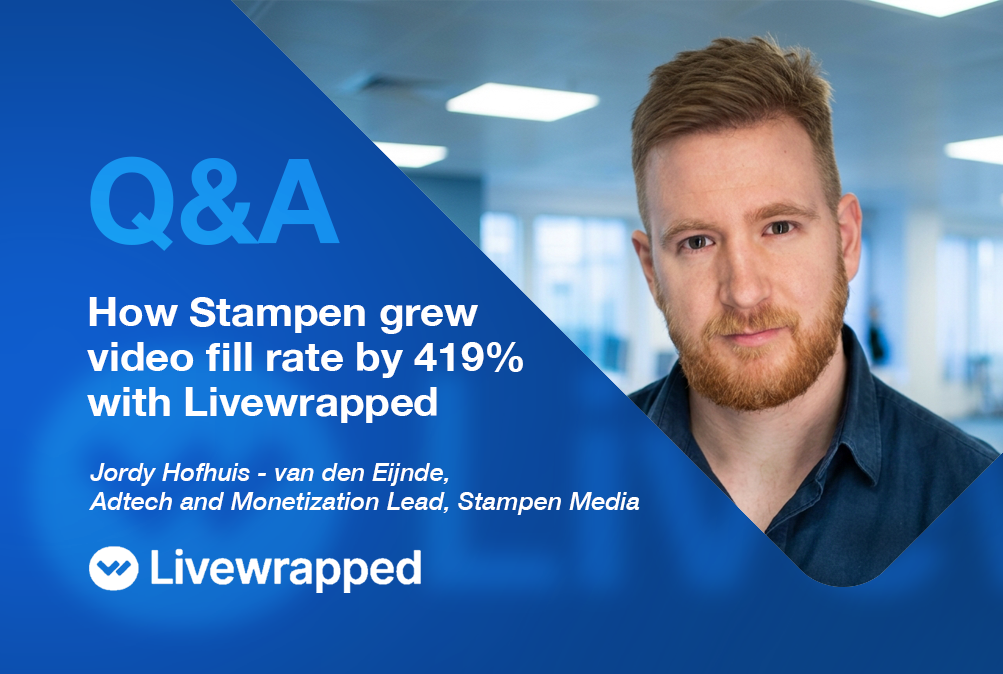
Earlier this year, Stampen Media moved its video demand from the ad server into the header, and its instream video fill rate rose dramatically as a result. That move also paved the way for what came next.
The editorial team was moving towards vertical video, but its ad business was still built around horizontal formats. So in September, for the first time ever, they created a way for vertical and horizontal video ads to compete for the same ad space.
We spoke to Jordy Hofhuis - van den Eijnde about how the team at Stampen moved video demand into the header, selling both formats on the same inventory, and what makes an adtech partnership work.
Can you tell us more about how Livewrapped fits into Stampen Media’s ad stack?
JH: As one of Sweden’s largest media groups, with 1.4 million readers per week across 16 sites, we need to work with partners who can help us monetise them without losing control over how our ads are set up. Livewrapped plays a central role in establishing advertising space on our online inventory. That includes deploying appropriate third-party scripts to ensure correct rendering, and helping us make an informed decision about which advertiser is most suitable for that space.
Oftentimes, it comes down to auction dynamics, but not always. While Livewrapped is easily dismissed as simply a wrapper, we use them for a variety of functions outside of making a Prebid auction happen.
The relationship goes back a long time before I joined. Livewrapped is based in the same city as us, Gothenburg, and a lot of their staff are former Stampen employees, which means they have a good understanding of what we’re trying to achieve.
Earlier this year, you moved your video demand from the ad server into the header. What difference has that made?
JH: Prebid video is well established, but across the Nordics, plenty of video demand still comes through tag-based integrations in the ad server. This means making header bidding the first and largest demand channel for video is still fairly uncommon in Sweden, for example.
Livewrapped helped us move all our online video demand from the ad server to the header at the beginning of this year. The only exception is our primary ad server, and we no longer have any passback tags. In Sweden, I think we’re one of only two publishers doing this, and the first and largest among news publishers.
In a passback waterfall, each partner gets a turn and passes the impression on if it doesn’t want it. The longer that goes on, the worse the latency gets, so the ad takes ages to load, viewability suffers and the inventory ends up being low quality. Removing that process brought all these parties into one room and allowed more of them to bid at the same time.
Since the move, we increased our fill-rate for instream video inventory by over 400%. CPMs are suitable for the local market and available inventory is stable. This is growth, plain and simple.
What’s more, we couldn’t have run horizontal and vertical video together if we’d stayed in the ad server.
And you’ve also overcome challenges with vertical video ads. What were they and how did you and the Livewrapped team work through them?
JH: Video has been a focus for us since before my joining Stampen in 2025. Our editorial team had pushed for vertical video, but our ad business was stuck in horizontal. Video ads have to match the size of the player, so rolling out vertical ads under the old infrastructure would have killed our horizontal video business.
We discussed this with Livewrapped and figured out that we could run separate auctions for different sizes. We built that system in-house, based entirely on Livewrapped, and they were a valuable partner throughout. For instance, they accommodated the dual bid requests that running two auctions creates, and helped whenever we got stuck.
In plain English, vertical and horizontal video ads can now compete for the same instream player. To my knowledge, we’re the first publisher that can offer vertical video in considerable volume, across all instream players, without threatening horizontal video revenues.
This may become commonplace within a year or two, but right now, we’re the first out there, and it wouldn’t have run as smoothly without Livewrapped (and of course, our very own rock-star programmer, Liselotte Jakobsson).
What do you anticipate the commercial or operational impact to be?
JH: For advertisers, this is very much about being able to move creatives filmed for social media over to us. Advertisers have had to create different content for different channels, and this opens up more inventory and a different quality of inventory, because completion rates are poor on social media (a recent Australian study put Meta at under 5% on average) but quite decent on news sites (our instream inventory is at around 74%).
For us, it means we can maintain our horizontal video business and also grow a vertical video business on the same inventory. It essentially doubles our potential for video sales.
You like to bring ideas to the Livewrapped team and talk things through. How does that working relationship compare with other vendors you’ve dealt with?
JH: Haha! That’s a really polite way of saying that we frequently bother Livewrapped with insane feature requests. We have a lot of respect for their expertise and the value of their time. That said, this is an industry where additional revenue sometimes comes at the cost of control due to one-size-fits-all settings, and we might be a bit more proactive than others in making suggestions.
For example, one SSP only listened to the first five to 10 sizes in the size array. We made a feature request, and now Livewrapped offers a much larger array of bidder parameters so that we can, among other things, prioritise sizes per bidder. In turn, this will help increase profitability from that SSP by making it focus on profitable ad sizes. It also opens up a whole new world of opportunities when it comes to sending custom signals per bidder for various use cases.
We have a dedicated Slack channel with Livewrapped, and they respond almost immediately to confirm whether something is doable, and how long it will take. Hands down, it’s a 10-out-of-10 for service.
What’s next on your roadmap with Livewrapped?
JH: Increasing our vertical video sales is a big focus. The expanded bidder parameters also have a wide array of functions, and it recently hit me that we’ve been under-using them. They dovetail really neatly into my plans for a new auction-flooring setup that we’re eager to test. So we’ll see whether we end up with any new crazy feature requests there.
If you’re looking for an adtech partner that will work through your most ambitious ideas with you, talk to the Livewrapped team today.