Delivering high-impact ads: Q&A with Henrik Carlsson

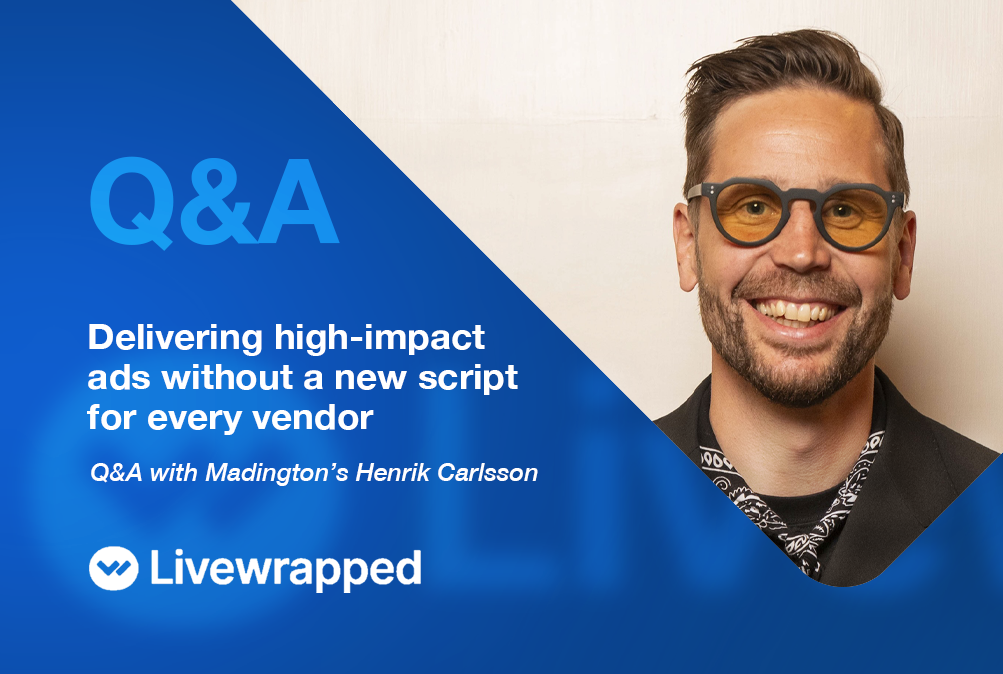
High-impact ads can be hard to scale when every new vendor calls for another technical setup. In August, Madington and SeenThis announced High-impact.js, an open-source framework intended to give publishers a common starting point. We spoke to Henrik Carlsson, Madington's CEO, to get the lowdown on what it means for publishers, and why buyers could benefit, too.
### Hi Henrik, what is High-impact.js, and what problem are you solving by co-developing it as an open-source, vendor-neutral framework rather than another proprietary product?
HC: Think of a topscroll. If every vendor needs different code on the publisher's site, adding a partner means more work for the ad ops team. High-impact.js brings together Advantage and SeenThis's original library. It gives publishers a common standard in the form of a shared, open-source framework for high-impact formats, while vendors compete on the quality of what they build with it. We think this could really help publishers scale the formats and attract more demand.
You talk about publishers regaining ownership of the code running on their sites. In practical terms, what changes for a publisher's ad ops team the day they adopt High-impact.js, compared with how they've had to handle topscrolls, midscrolls and similar formats until now?
HC: The aim is to implement the framework once, then use it to support formats from different vendors. Previously, each new vendor could mean custom JavaScript and repeated testing. Troubleshooting and maintenance multiplied with each vendor. With High-impact.js, publishers can host the library on their own domain, so they're in control of the underlying code.
There's still site work, because most pages need layout adjustments. But for the ad ops team, the goal is to have one framework to manage instead of a separate proprietary setup for each vendor. So a topscroll may need to push the page content down, while a midscroll may need to run across the full width of the page. In each case, a publisher can make those layout changes when an ad appears, then reverse them after it closes.
### Where does Livewrapped fit into this? How does the framework work with Livewrapped's header bidding wrapper?
HC: Livewrapped is an important part of making the standard practical at scale, because its header bidding wrapper can work directly with a publisher’s existing programmatic setup. In other words, publishers connected to Livewrapped can support High-impact.js out of the box, rather than having to start a separate integration project every time they want to introduce the standard.
That is a major part of the value proposition, because again, we don't want the adoption of an open standard to create another technical hurdle for the ad ops team. Instead, the infrastructure should fit into the ecosystem publishers are already using.
### From the buy side, WPP and Bonnier have both said fragmentation has held back scale. Do you expect an open standard to change how agencies plan and budget for high-impact formats, and could that unlock more programmatic demand for publishers?
HC: Yes, I think it could. Both WPP and Bonnier have described the problems caused by inconsistent implementations. Until now, agencies have had to account for the complexity of formats behaving differently from one publisher or vendor to the next. If formats behave more predictably, they can now start to plan high-impact as a category and include it more confidently in programmatic strategies.
And more publishers could offer it as those barriers fall. That could bring more demand and competition for publishers, with more choice for advertisers. Of course, the scale of any change depends on adoption.
### Finally, on results: what kind of lift are you expecting, whether in integration time, fill rates, viewability, CPMs or ROAS? And looking ahead, what would success for High-impact.js look like 12 months from now?
HC: First, I'd expect far less time spent integrating each new publisher or vendor. With one framework, they won't have to solve the same delivery problems again. Over time, we'd expect more available inventory and improved fill rates, with potentially stronger economics for publishers. I wouldn't reduce success to a single KPI, though, because the aim is to remove a bottleneck for the whole market.
In 12 months, I'd love to see publishers using one standard for multiple vendors and agencies to buy those formats more easily. High-impact.js would no longer be seen as a new initiative, but simply as part of the infrastructure for high-impact advertising. And of course, once the framework becomes part of the everyday workflow, vendors could focus on better creative experiences instead of proprietary integrations.
This new standard could give publishers more control over high-impact formats while making them easier for advertisers to buy. Livewrapped can support High-impact.js in its existing header bidding setup, while publishers add the framework to their sites and adapt the formats to their pages. If you'd like to explore what that could mean for your inventory, talk to the Livewrapped team.